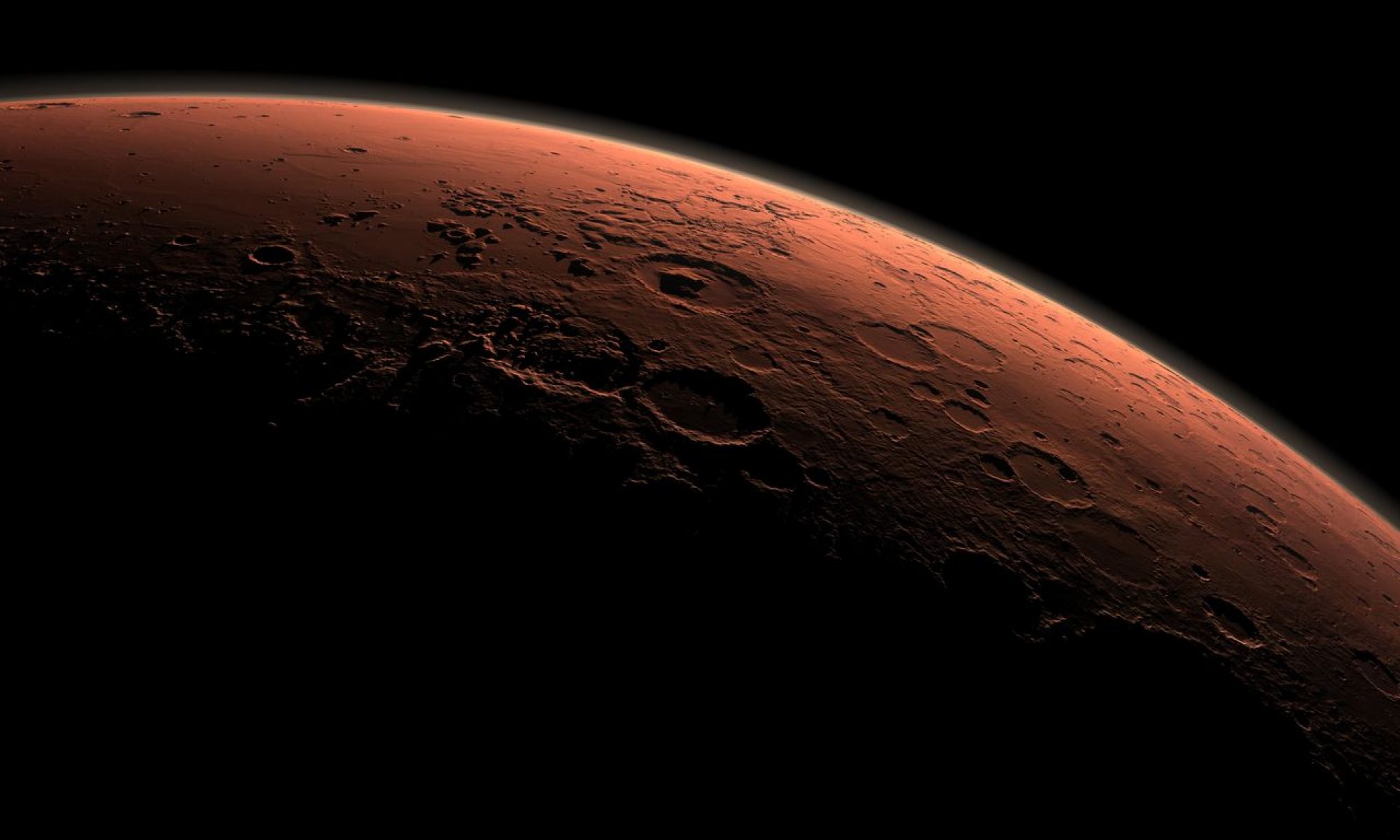
I am a Planetary Science PhD student at Arizona State University. While I am into all things space, I find planets especially captivating. Some of my specific interests include cratering physics and applications, volatiles (especially water ice), planetary surface processes, and extrasolar planets.
I have interned at the NASA Jet Propulsion Laboratory during the summers of 2018, 2019, 2020, and 2021. I work with my mentor, Catherine Elder, to study the regolith layer of the Moon using rock abundance surrounding Cold-Spot Craters. I am working on a scientific paper reporting my findings on the varying depth of the regolith layer, which helps us understand the geologic history of the Moon.
I am now a 3rd year PhD candidate at ASU where I study impact craters on Mars and use them as a tool to search for subsurface ices. I specifically study crater depth/diameter (d/D) ratios as potential indicators of subsurface ice from the time of impact and I also assess the formation mechanisms of rampart craters and their characteristic ‘fluidized’ ejecta with my primary advisor Jim Bell. Additionally, I study binary M stars and brown dwarf companions as well as telescope spectroscopy of jovian moons with my secondary advisor Jenny Patience.
My long-term goal is to be a research scientist or professor.
Impact Craters
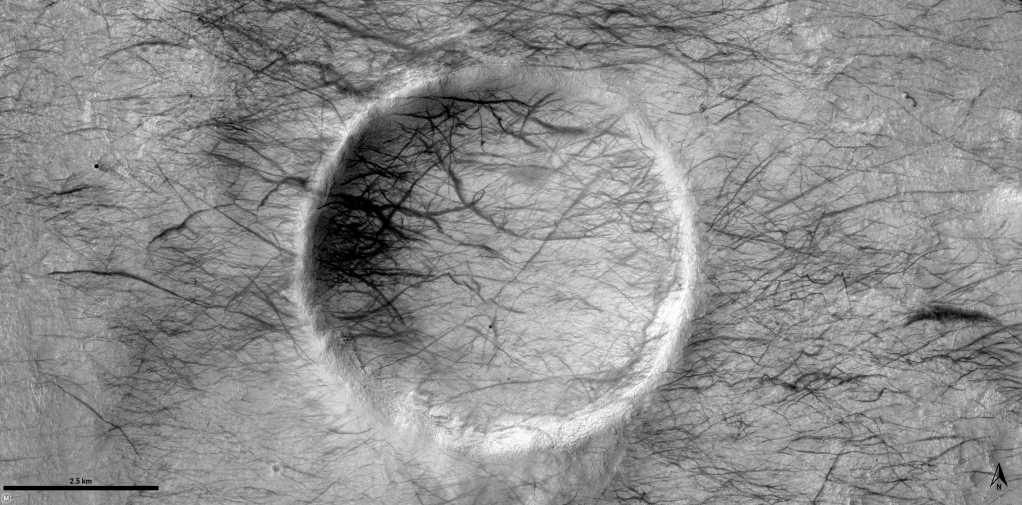
I began my scientific career investigating impact craters on the Moon and have since expanded to craters on Mars and other planetary bodies. Impact craters form when a meteoroid collides with a planet’s surface, releasing explosive energy that carves out the familiar bowl-shaped depression. My work primarily focuses on simple craters—kilometer-scale bowl-shaped structures in a planetary surface. In contrast, larger craters often exhibit complex morphologies, including central peaks and terraced walls. The structure and features of these craters provide valuable insights into subsurface properties at the time of impact, as well as the dynamic processes that have shaped them over time since formation. I specialize in using impact craters as a tool to study planetary subsurfaces, exploring components ranging from volatiles such as water ice to regolith and boulder populations.
Ongoing projects include:
- Studying crater d/D ratios on Mars to assess the potential span of subsurface ice from the poles;
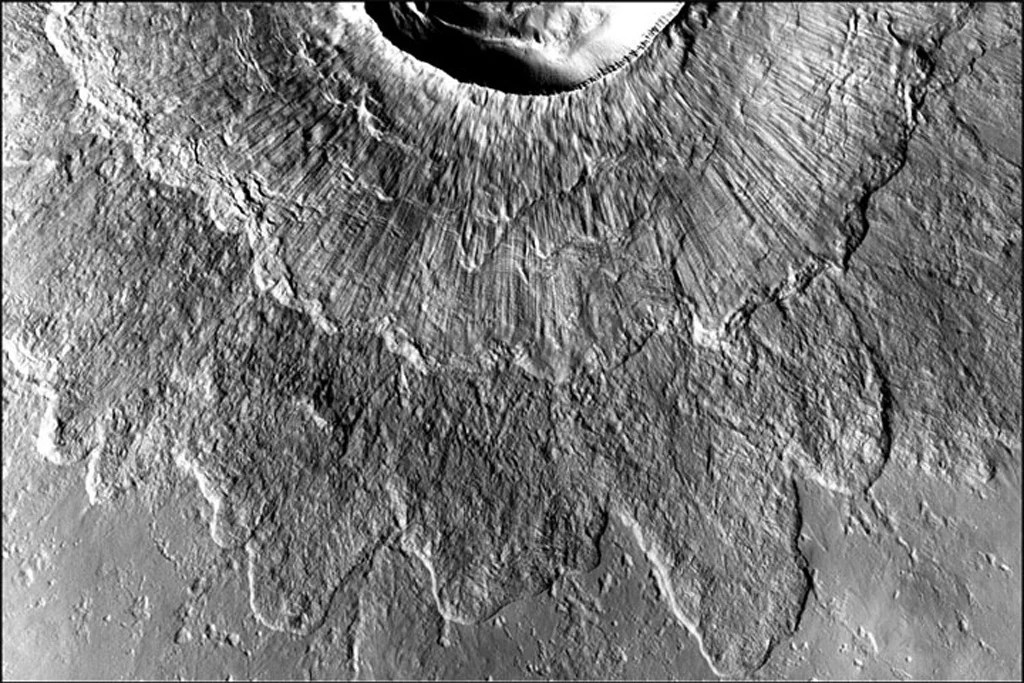
- Assessing the formation mechanisms of rampart craters with ‘fluidized’ ejecta;
- Constraining the depth of regolith in the lunar Maria using boulder populations in the ejecta of cold-spot craters;
- Measuring the spectra of jovian moons using the Large Binocular Telescope (LBT) ALES instrument;
- Analyzing LBT direct images of binary M-stars and brown dwarf companions.
Publications, Posters, and Talks:
The Subsurface Coherent Rock Content of the Moon as Revealed by Cold‐Spot Craters (2019 JGR Publication)
C. M. Elder, B. Douglass, R. R. Ghent, P. O. Hayne, J.-P. Williams, J. L. Bandfield, E. Costello
Publication: Journal of Geophysical Research – Planets
https://agupubs.onlinelibrary.wiley.com/doi/abs/10.1029/2019JE006128
Constraining the Thickness of the Lunar Regolith Using Cold-Spot Craters (2021 LPSC Talk)
Douglass, B., & Elder, C. M.
52nd Lunar and Planetary Science Conference (No. 2548, p. 2668).
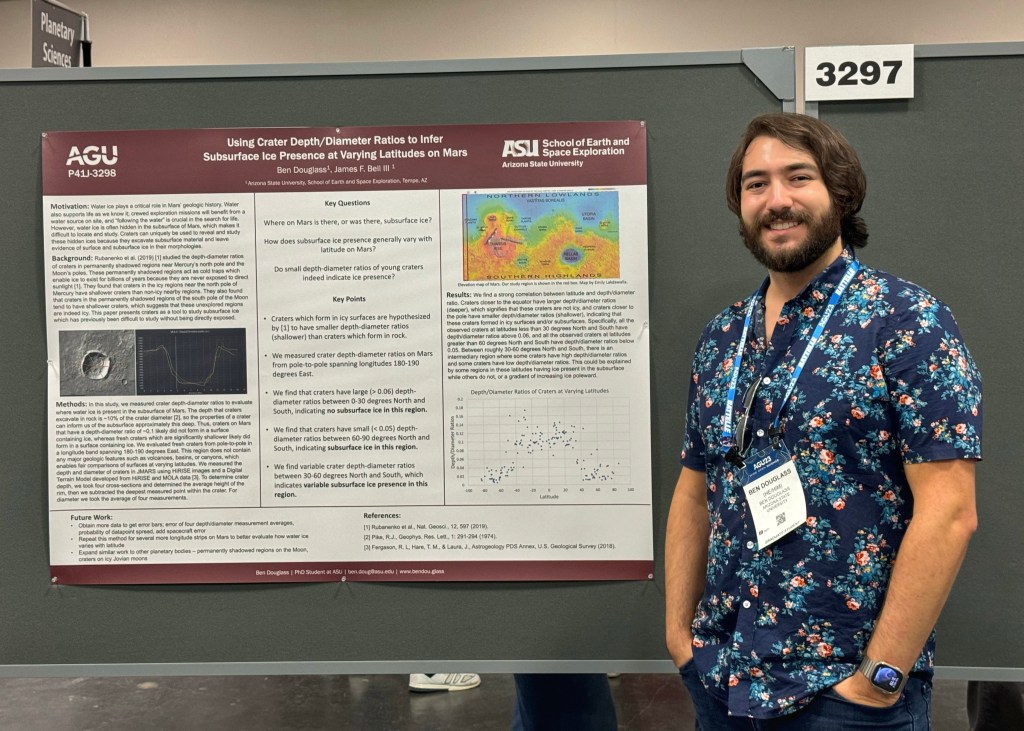
Using Crater Depth/Diameter Ratios to Infer Subsurface Ice Presence at Varying Latitudes on Mars (2023 AGU Poster)
Douglass, B., & Bell, J. F.
AGU Fall Meeting Abstracts(Vol. 2023, No. 3298, pp. P41J-3298).
Using Impact Crater Depth/Diameter Ratios and Geomorphology to Search for Evidence of Subsurface Ice on Mars (2024 AGU Poster)
Douglass, B. S., & Bell, J. F.
LPI Contributions, 3007, 3484.
Mastcam Multispectral Analysis of Dark-Toned Veins Above the Marker Band in Gale Crater, Mars (MSL Meeting Talk 2023)
Trussell, A. R., Douglass, B., Bell, J. F., Farrand, W. H., Kah, L. C., Johnson, J. R., & Eng, A. M.
I have a couple research projects with full paper drafts and plan to publish at least one of these as first author in 2025.
 bendou.glass